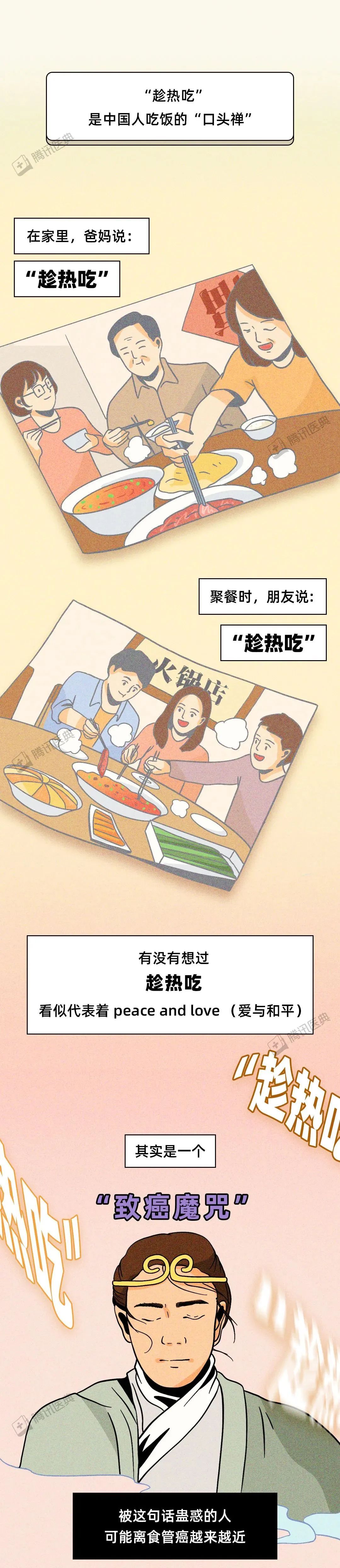

立即停止!这1个吃饭习惯会致癌,很多人却天天做
审稿专家:罗孔嘉 中山大学肿瘤防治中心主任医师 参考文献 [1]https://gco.iarc.fr/today/home [2]何三纲. 口腔解剖生理学(第8版)[M]. 北京:人民卫生出版社,2020. [3]Koranne K, Basu-Ray I, Parikh V, et al. Esophageal Temperature Monitoring During Radiofrequency Ablation of Atrial Fibrillation: A Meta-Analysis[J]. Journal of Atrial Fibrillation, 2016, 9(4):1452. [4]肖红梅,王少康,孙桂菊.饮茶和食管癌关系的研究进展[J].食品科学, 2016:288-292. [5]中华人民共和国国家卫生健康委员会医政医管局。食管癌诊疗指南 (2022 年版)[EB/OL]. https://www.nhc.gov.cn/cms-search/downFiles/da4d1b88634146a09fd63ccc5d728dc7.pdf, 2022-04. [6]国家卫生健康委员会. 食管癌诊疗指南(2022年版)[J/OL]. 中华消化病与影像杂志(电子版), 2022, 12(2): 81-110. [7]吕翔.《消化系肿瘤病理学》[M].南京:江苏科学技术出版社,2008. [8] Loomis, Dana, Guyton, et al. Carcinogenicity of drinking coffee, mate, and very hot beverages.[J]. Lancet Oncology, 2016. [9]lslami F, Poustchi H, Pourshams A, et al. A prospective study of tea drinking temperature and risk of esophageal squamous cell carcinoma[J]. International Journal of Cancer, 2020. [10]苗群爱,李峥,阮建平,黄瑞哲.陕西省口腔粘膜病相关危险因素分析[J].口腔 医学,2010:57-59. [11]UP TO DATE.儿童口腔软组织病变